
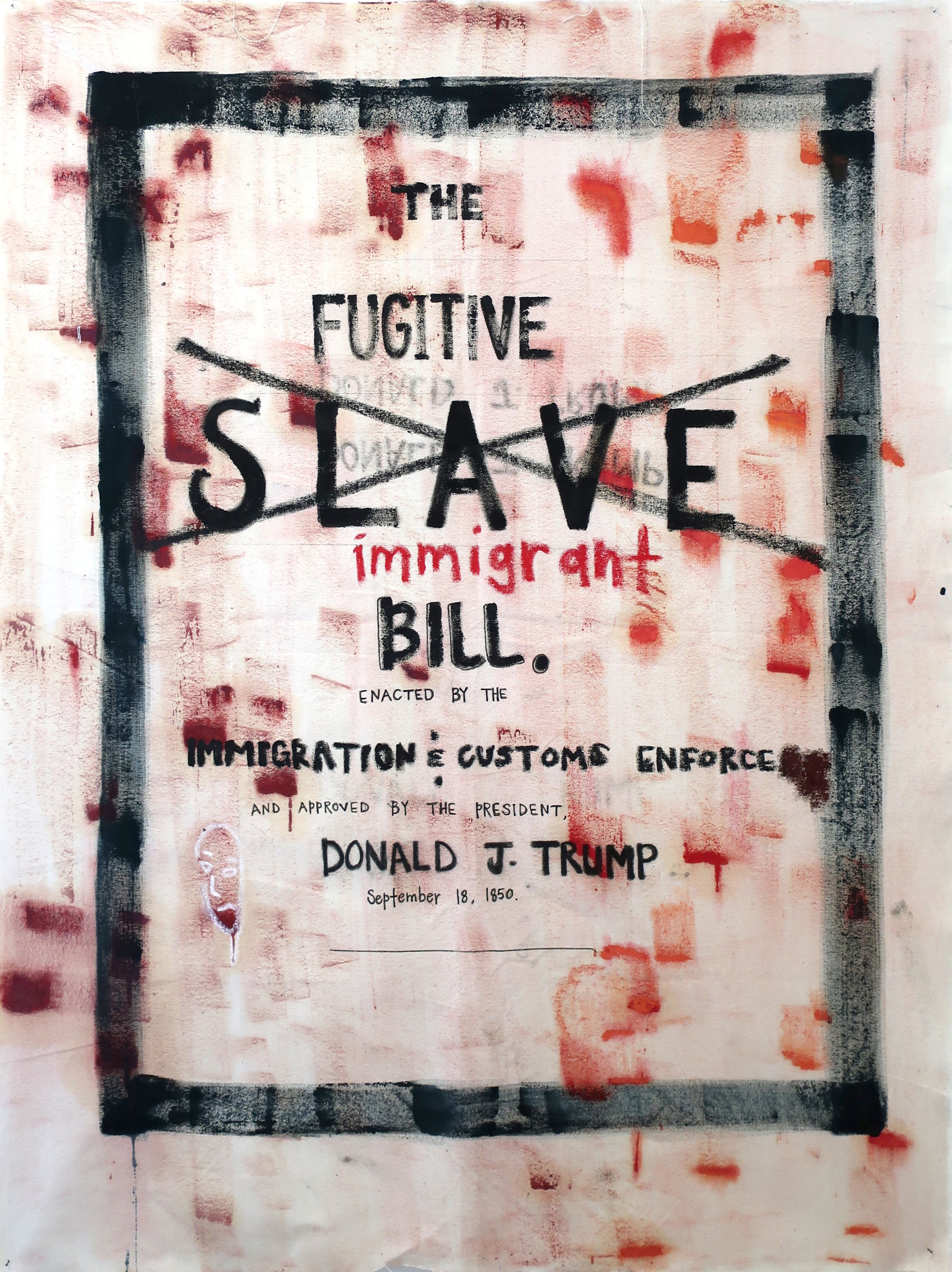
The Fugitive Immigrant Bill draws a direct and unsettling parallel between the Fugitive Slave Act and contemporary immigration enforcement practices in the United States. By revisiting a legal framework that once incentivized the capture and return of escaped enslaved individuals through financial bounties, the work questions the persistence of similar mechanisms in present-day systems of surveillance and reporting.
The installation juxtaposes archival footage from the Civil Rights era in Mississippi with material from the Parchman prison trials, exposing the continuity of carceral violence across decades. These historical documents are positioned alongside current realities within immigration detention centres, suggesting that the logic of control, punishment, and displacement has not disappeared, but rather evolved in form.
Collapsing the temporal distance between 1850 and 2026, Meshel constructs a visual and conceptual continuum in which past and present are inseparable. The work resists metaphor, instead insisting on recognition: what appears as progress may, in fact, be repetition under a different name.
Projection and oil on canvas
130 x 97 cm | 51.18 x 38.19 in
Delivery details will be sent privately to each buyer.
Taxes, shipping and handling is not included.
The Fugitive Immigrant Bill draws a direct and unsettling parallel between the Fugitive Slave Act and contemporary immigration enforcement practices in the United States. By revisiting a legal framework that once incentivized the capture and return of escaped enslaved individuals through financial bounties, the work questions the persistence of similar mechanisms in present-day systems of surveillance and reporting.
The installation juxtaposes archival footage from the Civil Rights era in Mississippi with material from the Parchman prison trials, exposing the continuity of carceral violence across decades. These historical documents are positioned alongside current realities within immigration detention centres, suggesting that the logic of control, punishment, and displacement has not disappeared, but rather evolved in form.
Collapsing the temporal distance between 1850 and 2026, Meshel constructs a visual and conceptual continuum in which past and present are inseparable. The work resists metaphor, instead insisting on recognition: what appears as progress may, in fact, be repetition under a different name.
Projection and oil on canvas
130 x 97 cm | 51.18 x 38.19 in
Delivery details will be sent privately to each buyer.
Taxes, shipping and handling is not included.