
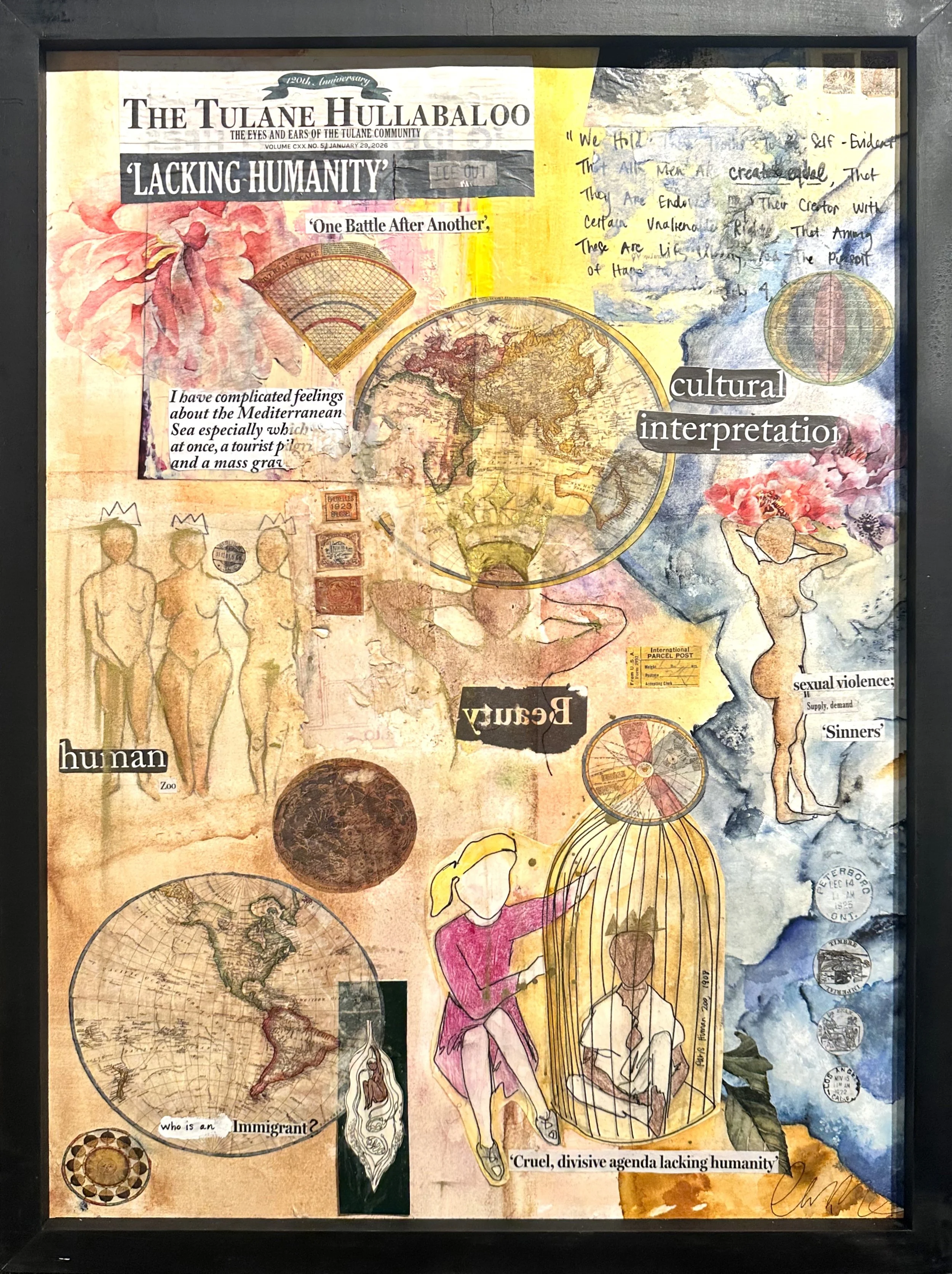
Drawing on archival material from so-called “human zoos” presented across Europe in the late 19th and early 20th centuries, including sites in Italy, France, and Belgium, History Does Not Repeat Itself, But It Often Rhymes confronts the systematic exhibition and objectification of non-European bodies within colonial frameworks of display.
The work incorporates visual references to documented cases in which individuals from regions such as the Philippines, Ghana, and the United States were presented as spectacles for public viewing. By recontextualising these histories, Meshel exposes the mechanisms through which bodies were categorised, racialised, and consumed under the guise of education or entertainment.
Central to the composition is the representation of women whose images are drawn from archival sources. Their bodies, often displayed in states of imposed nudity, reflect the ways in which physical difference was exaggerated and fetishised to reinforce colonial hierarchies and narratives of otherness. In this context, the act of display becomes inseparable from systems of control and dehumanisation.
The work extends beyond historical reference, establishing a parallel with contemporary structures of confinement and surveillance, particularly within immigration detention systems. Without collapsing distinctions between past and present, Meshel suggests a continuity in the visual and political logic that governs how certain bodies are seen, managed, and contained.
Rather than presenting history as a closed chapter, the piece insists on its persistence, asking viewers to consider not only what has been documented, but how similar patterns continue to shape present realities. In doing so, it frames history not as repetition, but as resonance, where past structures echo within contemporary forms.
Collage, watercolor, coloured pencils, gold ink, pencil
70 x 51 cm | 27.56 x 20.08 in
Delivery details will be sent privately to each buyer.
Taxes, shipping and handling is not included.
Drawing on archival material from so-called “human zoos” presented across Europe in the late 19th and early 20th centuries, including sites in Italy, France, and Belgium, History Does Not Repeat Itself, But It Often Rhymes confronts the systematic exhibition and objectification of non-European bodies within colonial frameworks of display.
The work incorporates visual references to documented cases in which individuals from regions such as the Philippines, Ghana, and the United States were presented as spectacles for public viewing. By recontextualising these histories, Meshel exposes the mechanisms through which bodies were categorised, racialised, and consumed under the guise of education or entertainment.
Central to the composition is the representation of women whose images are drawn from archival sources. Their bodies, often displayed in states of imposed nudity, reflect the ways in which physical difference was exaggerated and fetishised to reinforce colonial hierarchies and narratives of otherness. In this context, the act of display becomes inseparable from systems of control and dehumanisation.
The work extends beyond historical reference, establishing a parallel with contemporary structures of confinement and surveillance, particularly within immigration detention systems. Without collapsing distinctions between past and present, Meshel suggests a continuity in the visual and political logic that governs how certain bodies are seen, managed, and contained.
Rather than presenting history as a closed chapter, the piece insists on its persistence, asking viewers to consider not only what has been documented, but how similar patterns continue to shape present realities. In doing so, it frames history not as repetition, but as resonance, where past structures echo within contemporary forms.
Collage, watercolor, coloured pencils, gold ink, pencil
70 x 51 cm | 27.56 x 20.08 in
Delivery details will be sent privately to each buyer.
Taxes, shipping and handling is not included.